Other FIT Wellington pages:
- A New Public Transport Approach
- A Suggested Route
- Advancing Light Rail for Wellington
- Advocacy or Consultancy
- Are we on track
- Art of Light Rail Insertion
- Auckland Light Rail Options
- Briefing to Transport Minister
- Bus and Light Rail in Central Wellington
- Bus Rapid Transit is Unsuitable
- By the Numbers
- Can Light Rail Attract Enough Demand
- City of Well Connected Communities
- Comparing Canberra and Wellington
- Congestion Free Wellington
- Draft GPS on Land Transport
- Estimating Travel Time
- FIT Wellington
- Funding Light Rail
- Glossary
- Golden Mile Trial
- Harbour Quays Talking Points
- Letter to Capital Magazine
- LGWM Options Feedback
- LGWM Personal Submission
- LGWM Submission
- Light Rail Costs
- Light Rail Design Brief
- Light Rail FAQ
- Light Rail Options Survey
- Light Rail Planning Assumptions
- Light Rail to Lincolnshire Farms
- Making Tram-Train Work
- Mass Rapid Transit in Wellington
- Mass Rapid Transit Talking Points 2026
- Ministerial Talking Points
- Move More People with Fewer Vehicles
- Moving on from LGWM
- Myth Busters
- N2A Talking Points
- NZTA Talking Points
- Open Letter on Trackless Trams
- Open Letter to LGWM
- Paul Swain Monday 1 February 2016
- Planning Principles
- Public Transport in Wellington
- Public Transport Spine Issues
- Public Transport Spine Study
- Public Transport Spine Workshop
- Spatial Plan Submission
- Submission on Harbour Quays Proposal
- The Case for Light Rail
- Three Minute Summary
- Towards Low Emission Cities
- Track Gauge
- What Makes Light Rail Succeed
- What Next for Transport in Wellington
- Workshop Code of Conduct
Wellington faces a decision as to whether we are trying to build a transport network to serve the motor vehicle or one which will best serve people. If we are building a transport network to serve the motor vehicle, the SH1 Wellington Improvements would be a good place to start. But if we are building a transport network to serve people, the SH1 Wellington Improvements are a good place to stop.
PDF settings (show)
As a resident of Wellington Central, I consider this car-centred project ill-advised. It will do little more than shift congestion bottlenecks, while degrading the built environment and pedestrian realm through the central city. NZTA would do better to return to the strategy it adopted for the Let’s Get Wellington Moving programme — move more people using fewer vehicles.
NZTA is ignoring its own advice, that new infrastructure builds should be the last resort (see Intervention hierarchy). Turn the other knobs first, to make the existing transport network more productive.
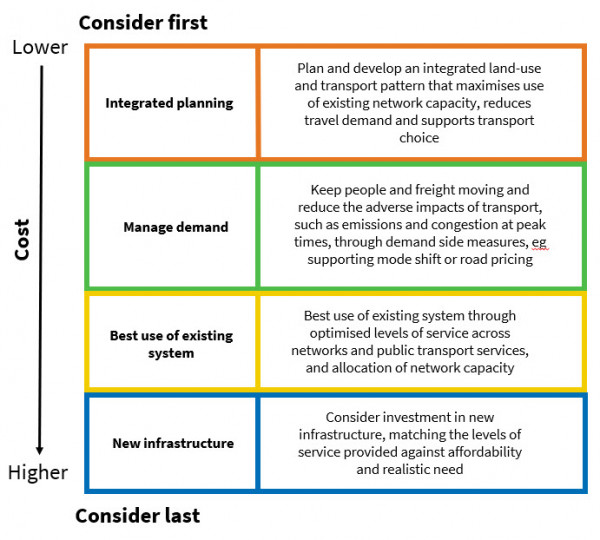
▴ Intervention Hierarchy
The investment case for the SH1 Wellington Improvements needs to show that it represents better value for money than the alternative of investing in improved public and active transport infrastructure. I support the proposed alternative, published on the City for People website (selectively quoted below).
Easing general traffic congestion: travel demand-management to flatten the peak. Includes congestion charging but also other tools like parking management. It’s vastly cheaper than building new tunnels, and helps us make better use of the road space we already have. It works because motivating just a small percentage of the travelling public to change something about their travel choices — be it the time or vehicle/mode they travel by, and even just changing a little bit — makes a big difference.
Easing general traffic congestion and making bussing way better: unblock the bus network through the city centre by making a “second spine” of bus priority. It’s hugely cheaper: paint, signs, traffic lights and timetabling. It will take ~60% of the bus movements off the Golden Mile, meaning we can have more buses that serve us quicker, more reliably and freeing up the Golden Mile for a nicer experience walking, sitting out, meeting people, shopping…
Making it nicer and safer to walk around the centre, especially for more vulnerable Wellingtonians (disabled people, kids, older people): six much cheaper things than more highway space.
- Tweak traffic lights to give people more time to cross roads
- Enforce genuine 30kph traffic speeds
- Widen footpaths and narrow crossing distances
- Prioritise more mobility carparking over general parking, and more parking enforcement
- Smooth the ramps between footpath and road
- Get scooters off footpaths into general lanes or cycle lanes
Unlike the NZTA proposal, this alternative will improve travel for everyone, not just those travelling in motor vehicles (while making travel worse for everyone else).
If we are dead-set on stupidly expanding road space, let’s do the least-worst stupid-road-space-expansion project. Amend the current design to mitigate its avoidable and major adverse impacts.
Make buses best through the Basin. Separated, fulltime bus priority through the Basin Reserve area both ways.
- Free buses from mingling with general traffic because they carry way more people. Prioritise their crossing the highway travelling north-south — because remember they carry way more people — and separate them travelling east–west so they don’t get stuck in the general traffic.
- Do not do this half-baked (part-time bus priority that confuses everyone, requires complex signage and loads of enforcement, and that’s vulnerable to short-term retraction while delivering only some of the goods).
- For bonus points: fund the second spine — what was always going to actually unblock the central city, for everyone. Fulltime bus priority, that actually makes good on the “potential” for less traffic between our city and our harbour that NZTA dangle in their promotion.
- The 2019 Bus Priority Action Plan is a brilliant document and (for once) with solid commitment from both councils. Execute it.
Make a way better Mt Vic tunnel experience for humans. Separated space for people walking, from people going fast on wheels, and both protected from cars.
- They’re spending $2.9–$3.8 billion dollars of our money and the best NZTA’s own comms people can say for the design’s provision for people walking, scooting, wheeling and cycling is that it’s “better than status quo”. There’s still people going fast on wheels amongst people going slowly on feet and wheelchairs in a narrow confined space. Oh, with slightly fewer exhaust fumes and deafening traffic noise — lucky us. For $2.9–$3.8 billion dollars.
- This is an embarrassment. Genuinely separated space is essential and given the people-carrying efficiency of rori iti and footpaths versus car lanes, absolutely worth more tunnel space.
Prevent the extra traffic of its induced demand from ruining big tracts of the city. Building more space for cars will, initially, make driving nicer. What does that mean?
- More people drive, more — and not just through the centre non-stop. Including “popping down to Moore Wilsons” and “going to pick the kids up cos it’s raining” and and and…
- The extra traffic turning on and off the expanded highway at all the north–south junctions (Willis / Cuba / Victoria / Taranaki / Tory, and Wellington / Moxham / Walmer / Hamilton) will impose the “offramp effect” onto those neighbourhoods: more traffic, going faster because it’s about to get on / has just come off a zoomy big highway-feeling road. (See: Auckland neighbourhoods.)
- Te Aro and Hataitai are car-dominated enough as it is, and they’re places where lots more people want to live and do stuff. Just as they’re starting to get going, extra traffic will blight them for decades to come. NZTA must prevent this — all this induced demand is entirely caused by making more driving space.
Yes, these improvements will slow traffic on the new highway. It’s a city. Fast traffic isn’t appropriate through a city centre.
With no discussion of alternatives NZTA considered and rejected, “community engagement” presents the proposal as if “there is no alternative”. NZTA’s approach has left the impression that the project is a done deal, engagement is for form’s sake only, and submission is a waste of time.
NZTA needs to reject the plan for SH1 Wellington Improvements in its current form. Either invest in improving public and active transport infrastructure, to move more people using fewer vehicles. Or amend the design to mitigate its avoidable and major adverse impacts on those who are not in cars.
- ✒
- John Rankin
December 2025